
Dishwasher Dilemmas: Why Your Dishes Are Coming Out Cloudy or Wet
Nothing ruins a great dinner party or a quiet Tuesday night, quite like opening your dishwasher only to find that your plates are covered in a milky film and your glasses are dripping wet. You bought a dishwasher to save time, not to spend your evening hand-drying or re-washing “clean” loads.
When your dishwasher starts underperforming, it is rarely a mystery. Usually, it is a sign that a specific component is struggling or that your local environment is taking a toll on your machine. At A Absolute Appliance Repair Inc., we’ve seen every dishwasher disaster imaginable across Lake and McHenry counties.
If you are currently facing “dishwasher dilemmas,” here is an in-depth guide to why your dishes are coming out cloudy or wet and how you can fix it.
The Mystery of the Cloudy Glass: Is it Hard Water or Etching?
If your glassware looks foggy, the first step is determining the cause. There are two main culprits: hard water mineral buildup and “etching.”
1. Hard Water Mineral Buildup
In areas like Mundelein and Crystal Lake, hard water is a common reality for homeowners. High concentrations of calcium and magnesium in the water supply can leave a white, chalky residue on your dishes. As we’ve discussed in our guide on how hard water affects Chicago appliances, these minerals don’t just stay in your ice maker, they coat your dishwasher’s interior and spray arms, too.
- The Fix: Use a rinse aid. Rinse aids are designed to break the surface tension of water, allowing it to “sheet” off your dishes rather than forming droplets that leave spots. You can also run a cleaning cycle with a specialized dishwasher descaler or a bowl of white vinegar.
2. Glass Etching
Etching is more permanent. It occurs when the combination of very soft water, high heat, and too much detergent actually wears away at the surface of the glass. Unlike hard water spots, etching cannot be wiped away.
- The Fix: Use less detergent if you have a water softener, and try to avoid the “High Temp” setting for delicate glassware.
Why Are My Dishes Still Soaking Wet?
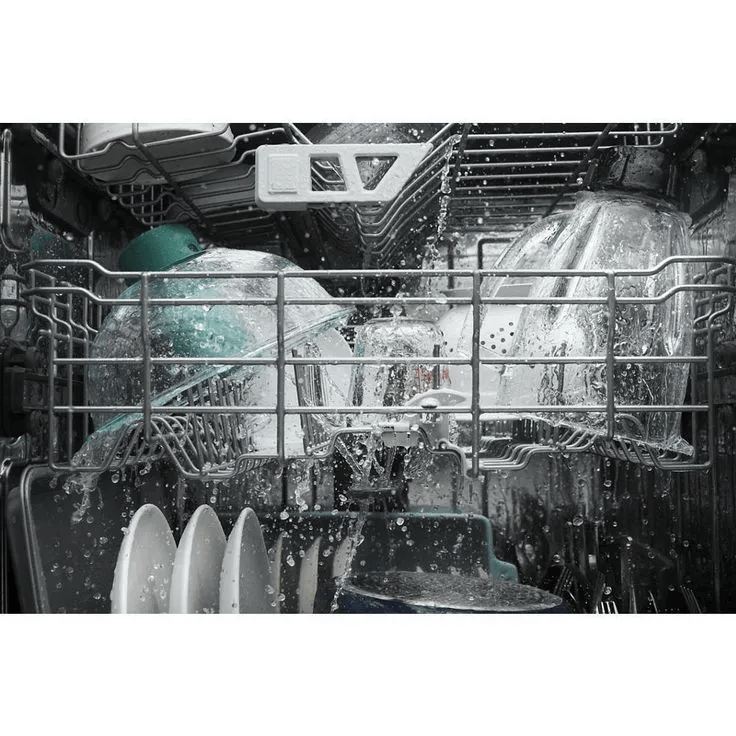
If you have to follow every cycle with a dish towel, your dishwasher’s drying system is likely failing. Modern dishwashers generally use one of two methods to dry: a heating element or condensation drying.
1. A Burnt-Out Heating Element
Most traditional American dishwashers use a metal heating element at the bottom of the tub. Over time, these elements can crack or burn out. If the element is broken, your dishes will remain cold and wet at the end of the cycle. Much like an electric oven vs. gas oven problem, a faulty heating element is a technical repair that requires a professional diagnostic.
2. The Fan or Vent Path
Some high-end models use a small fan to blow the moist air out of the unit. If the fan motor fails or the vent doesn’t open properly, the steam stays trapped inside, eventually turning back into water and settling on your dishes.
3. Skipping the Rinse Aid
We cannot stress this enough: most modern dishwashers (especially brands like Bosch, Samsung, and LG) are designed to be used with rinse aid. Without it, the drying performance can drop by as much as 50%.
Hidden Culprits: Clogged Spray Arms and Filters
Sometimes the “cloudiness” isn’t minerals, it’s actually tiny food particles that have been redeposited onto your “clean” dishes.
- The Filter: If you haven’t cleaned your dishwasher filter in the last few months, it is likely filled with a “sludge” of old food and grease. This prevents the water from draining properly and recirculates dirty water back onto your plates.
- The Spray Arms: Tiny holes in the spray arms can get clogged with seeds, toothpicks, or lime scale. When this happens, the water pressure drops, and the dishwasher can’t rinse away the detergent properly, leaving a soapy film.
Just like your laundry units, regular maintenance is a smart investment for homeowners that prevents these minor clogs from turning into major mechanical failures.
When to Call the Experts
While cleaning a filter is a great DIY task, many dishwasher issues involve electrical components, water inlet valves, or motor assemblies. If you’ve cleaned the filter and added rinse aid but your dishes are still dirty, it’s time for a professional look.
At A Absolute Appliance Repair Inc., we specialize in comprehensive dishwasher repair services across the suburbs. We know the specific quirks of major brands like Whirlpool, GE, and Samsung. Whether it’s a drainage issue or a heating failure, we offer same-day service in most cases to get your kitchen back in order.
Don’t let a faulty dishwasher increase your utility bills or ruin your kitchenware. Remember, we offer free service calls with repair and No extra charge for evenings & saturdays. We also provide a 3-year warranty on parts and a 1-year warranty on labor, ensuring your peace of mind.
If your kitchen is struggling, don’t stop at the dishwasher. We also offer expert refrigerator repairs and stove repair services to ensure your entire home runs smoothly.
Frequently Asked Questions (FAQs)
1. Why does my dishwasher smell like rotten eggs?
Ans: Food trapped in the filter or a clogged drain hose causes odors. Clean the filter; if smells remain, call for professional drain line cleaning.
2. Is it worth repairing a 10-year-old dishwasher?
Ans: If repairs cost over 50% of a new unit, replace it. Otherwise, high-quality models often last 12-15 years with maintenance.
3. Can I use dish soap if I run out of dishwasher detergent? No!
Ans: Liquid dish soap creates excessive suds that leak and damage internal sensors or the motor.
4. Why is there water left at the bottom of my dishwasher?
Ans: Clear water under the filter is normal. Standing “dirty” water indicates a clogged drain pump or a pinched drain hose.
5. How often should I clean my dishwasher?
Ans: Clean the filter monthly and run a deep-clean cycle every 3 months to remove grease and lime scale buildup.